
By Sedef Turper, Department of International Relations, Koç University
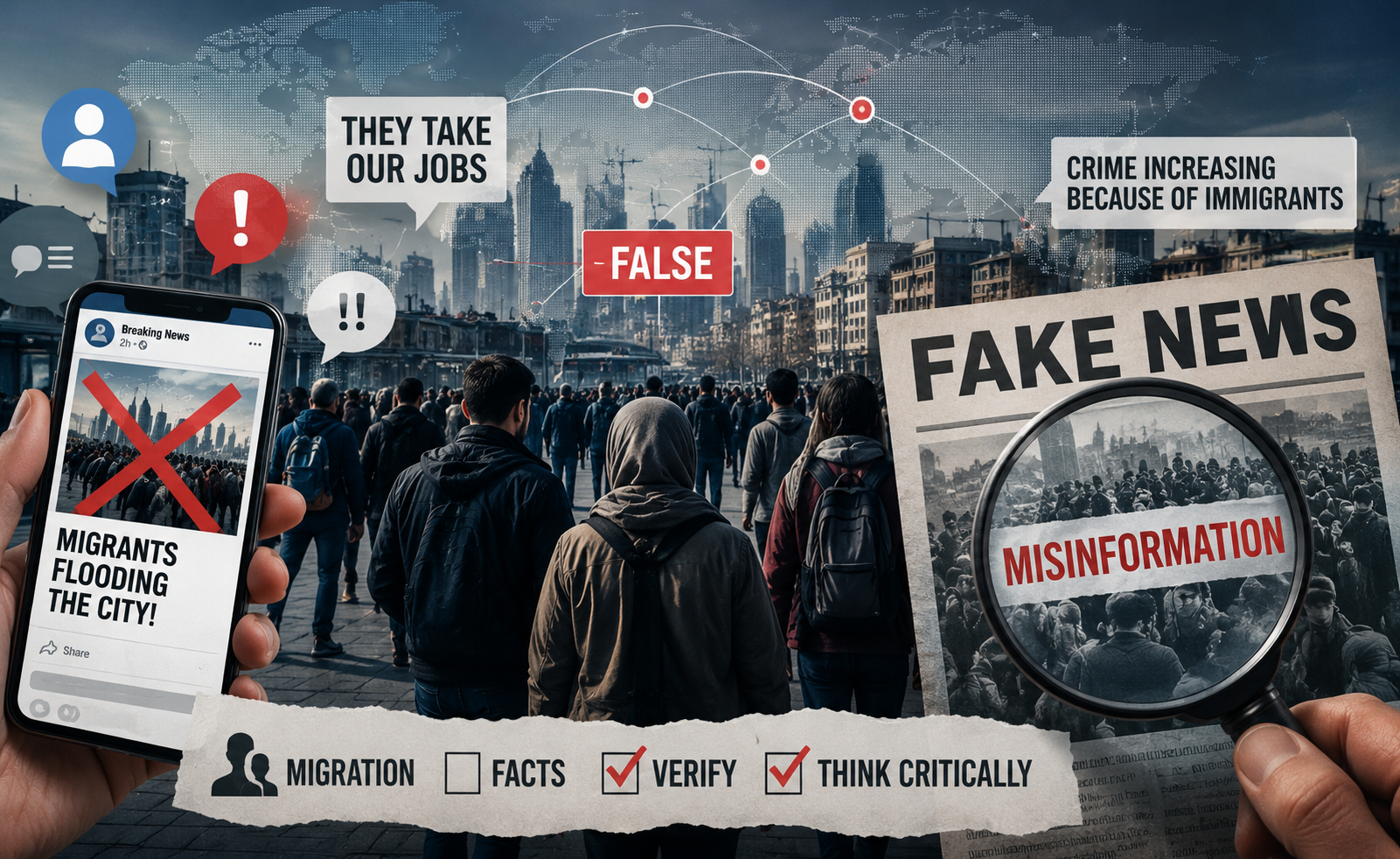
The circulation of dis- and misinformation about migration becomes increasingly prevalent especially during periods of mass mobility. Recently, we have witnessed a surge of migration-related inaccurate information following significant human displacements, such as those stemming from the Syrian Civil War and Russia’s invasion of Ukraine (Neidhardt, 2022). These inaccurate narratives often take the form of “fake news,” mimicking the stylistic elements of traditional journalism and circulating through seemingly authentic social media sources to gain unearned credibility (Chadwick & Stanyer, 2022; Egelhofer & Lecheler, 2019).
While the content may be identical, the distinction between disinformation and misinformation rests on the intent of the actor in disseminating the inaccurate information (Flynn et al., 2017). Disinformation is characterized by a deliberate attempt to deceive, often manufactured and put into circulation by agents seeking to manipulate public perceptions. In contrast, misinformation refers to the sharing of the same deceptive content without realizing that the core elements are fabricated. To illustrate the transition from intended to unintended dissemination of inaccurate information, one can consider the case of repurposed image of a rescue boat serving to feed the political tensions around US-Mexico border in February 2024. The image allegedly showing a large group of migrants being brought ashore by a lifeboat at the U.S.-Mexico border went viral on social media to propagate the message that U.S. border was completely “open” and that authorities were actively assisting the arrival of thousands of migrants. The post was quickly identified as a clear case of fabricated content accompanied by a photo capturing people being rescued from the English Channel by the British authorities two years back. Despite the fact-checking and debunking efforts, the shift to misinformation happened as the image was shared by thousands of users in the United States, reaching people who were genuinely concerned about border security. At this point, the original piece of disinformation was successfully transformed into misinformation, spreading rapidly through networks of trust.
Deceptive content about migrants and migration can tap into multiple dimensions of human mobility, ranging from the characteristics of immigrants to the scale of migratory movements as well as migrants’ impact on political, social, and economic life in the host countries. Much of this content relies on threat-based narratives. Migration-related disinformation frequently depicts immigrants as arriving in overwhelmingly large numbers, abusing welfare systems, receiving preferential treatment from governments, or contributing disproportionately to crime and social disorder. As such, migration-related disinformation plays an important role in shaping public perceptions not only of who the migrants and what the migration patterns are, but also of the rights, services, and opportunities available to migrants (Turper, 2026).
Why do inaccurate stories about immigrants so often resonate with the public?
Public attitudes toward immigrants and support for restrictive immigration policies are often shaped by two closely connected dynamics: threat perceptions and feelings of violated entitlement. Research on intergroup relations suggests that natives are more likely to develop negative attitudes toward immigrants when they perceive them as threatening their individual or collective well-being. These perceived threats may take many forms, including fears of economic hardship (Ben-Nun Bloom et al., 2015; Helbling & Kriesi, 2014; Valentino et al., 2017), rising crime rates (Mayda, 2006; McLaren & Johnson, 2007), erosion of national identity and cultural values (Schneider, 2008; Sniderman et al., 2004), or the loss of political influence (Stephan et al., 2005). Even though such concerns are important drivers of anti-immigrant sentiments they are not sole predictor of such attitudes. Hostility toward immigrants can also be driven by how natives perceive the relative position of their group vis-à-vis immigrants. Natives holding the historically rooted belief that they are entitled to exclusive or priority access to certain rights, resources, and privileges (Blumer, 1958) can also develop anti-immigrant sentiments when they perceive immigrants gaining access to those privileges, even when immigrants’ access to those privileges does not endanger natives’ own access to them (Meuleman et al., 2019).
This is precisely where migration-related misinformation can become especially influential. Inaccurate or misleading claims about immigrants receiving preferential treatment, being linked to rising crime, or posing security risks can make threat perceptions and feeling of resentment ignited or reinforced. As these claims circulate repeatedly through social media, news outlets, and political discourse, they can strengthen feelings of violated entitlements and perceptions of threat, which then translate into anti-immigrant sentiments and support for more restrictive migration policies.
What are the commonly held misperceptions among young urban residents?
Our experimental pilot study with university students in İstanbul demonstrates (Göksel & Turper, 2024) that commonly held misperceptions about Syrian refugees in urban contexts tend to cluster around exaggerated beliefs about rights, entitlements, and criminal offenses. In particular, many students overestimated the scope of social benefits available to refugees, including assumptions about free access to utilities, housing support, and unconditional access to university education. These social and economic misconceptions are accompanied by beliefs about citizenship rights, with a considerable share of respondents also believing that refugees can obtain citizenship if they choose to do so. Most strikingly, security-related misperceptions were especially prominent, with widespread agreement among respondents that refugees are frequently involved in criminal behaviour, particularly sexual offenses.
When do the correction interventions work?
The same study further suggests that corrective information can reduce misperceptions about migrants and migration policies, but not uniformly across domains or across individuals. Overall, exposure to corrective information tends to lower belief in misleading claims about refugee entitlements and can also soften negative attitudes by reducing threat perceptions and feelings of violated entitlements. However, qualitative evidence from focus group discussions indicates that the effectiveness of correction is strongly conditioned by trust in information sources. Students often express deep scepticism toward both state and media narratives and instead report selectively trusting independent fact-checking platforms or local authorities or non-governmental sources.
While corrections are generally effective in challenging misperceptions about rights and privileges granted to refugees, misconceptions related to safety and social order prove more resistant. Correction interventions aiming to debunk misleading content about safety risks refugees pose, did not significantly decrease concerns over safety, especially among the group of students who encounter refugees on a daily basis in their residential neighborhoods. Our focus group study revealed that, while belief in commonly circulated fake news about refugee offenders diminished, students living in immigrant-dense urban areas continued to form their attitudes based on personal experiences. Female students in these neighborhoods, where they frequently encounter refugees, expressed heightened concerns about their personal safety and reported high levels of anxiety about the presence of refugees. However, for those students who formed their opinion of refugees based not on their personal encounters but on inaccurate content widely circulated on social media, misinformation correction worked much more efficiently.
All in all, these findings suggest that while misinformation correction can meaningfully reshape entitlement-based perceptions, its capacity to fully dislodge security-related concerns remains more limited and context-dependent.
Acknowledgements
This blog post is built on extensive fieldwork conducted by Gülay Uğur Göksel and Sedef Turper. For further information on study findings you can access the project report here
References
Ben-Nun Bloom, P., Arikan, G., & Lahav, G. (2015). The effect of perceived cultural and material threats on ethnic preferences in immigration attitudes. Ethnic and Racial Studies, 38(10), 1760–1778. https://doi.org/10.1080/01419870.2015.1015581
Blumer, H. (1958). Race prejudice as a sense of group position. The Pacific Sociological Review, 1(1), 3–7.
Chadwick, A., & Stanyer, J. (2022). Deception as a bridging concept in the study of disinformation, misinformation, and misperceptions: Toward a holistic framework. Communication Theory, 32(1), 1–24. https://doi.org/10.1093/ct/qtab019
Egelhofer, J. L., & Lecheler, S. (2019). Fake news as a two-dimensional phenomenon: A framework and research agenda. Annals of the International Communication Association, 43(2), 97–116. https://doi.org/10.1080/23808985.2019.1602782
Flynn, D. J., Nyhan, B., & Reifler, J. (2017). The nature and origins of misperceptions: Understanding false and unsupported beliefs about politics. Political Psychology, 38, 127–150. https://doi.org/10.1111/pops.12394
Göksel, G. U., & Turper, S. (2024). Public opinion on refugee integration: Exploring the role of potential interventions: Vol. GAR Report.
Helbling, M., & Kriesi, H. (2014). Why citizens prefer high- over low-skilled immigrants. Labor market competition, welfare state, and deservingness. European Sociological Review, Online(5), 1–20. https://doi.org/10.1093/esr/jcu061
Mayda, A. M. (2006). Who is against immigration? A cross-country investigation of individual attitudes toward immigrants. The Review of Economics and Statistics, 88(3), 510–530.
McLaren, L., & Johnson, M. (2007). Resources, group conflict and symbols: Explaining anti-Immigration hostility in Britain. Political Studies, 55(4), 709–732. https://doi.org/10.1111/j.1467-9248.2007.00680.x
Meuleman, B., Abts, K., Schmidt, P., & Pettigrew, T. F. (2019). Economic conditions, group relative deprivation and ethnic threat perceptions: A cross-national perspective threat perceptions. Journal of Ethnic and Migration Studies. https://doi.org/10.1080/1369183X.2018.1550157
Neidhardt, A.-H. (2022). Disinformation on refugees from Ukraine: Boosting Europe’s resilience after Russia’s invasion. European Policy Centre. https://feps-europe.eu/publication/disinformation-on-refugees-from-ukraine-boosting-europes-resilience-after-russias-invasion/
Schneider, S. L. (2008). Anti-immigrant attitudes in Europe: Outgroup size and perceived ethnic threat. European Sociological Review, 24(1), 53–67. https://doi.org/10.1093/esr/jcm034
Sniderman, P. M., Hagendoorn, L., & Prior, M. (2004). Predisposing factors and situational triggers: Exclusionary reactions to immigrant minorities. American Political Science Review, 98(1), 35–49. https://doi.org/10.1017/S000305540400098X
Stephan, W. G., Renfro, L. C., Esses, V. M., White Stephan, C., & Martin, T. (2005). The effects of feeling threatened on attitudes toward immigrants. International Journal of Intercultural Relations, 29(1), 1–19. https://doi.org/10.1016/j.ijintrel.2005.04.011
Turper, S. (2026). Feeding the beast: The role of disinformation in shaping immigration policy preferences. International Journal of Intercultural Relations, 110, 102317. https://doi.org/https://doi.org/10.1016/j.ijintrel.2025.102317
Valentino, N. A., Soroka, S. N., Iyengar, S., Aalberg, T., Duch, R., Fraile, M., Hahn, K. S., Hansen, K. M., Harell, A., Helbling, M., Jackman, S. D., & Kobayashi, T. (2017). Economic and cultural drivers of immigrant support worldwide. British Journal of Political Science, 1–26. https://doi.org/10.1017/S000712341700031X